
The right starting point is an explanation of the heaviness
Heavy upper eyelids do not point to one operation. Double eyelid surgery creates or defines an upper-lid crease; upper blepharoplasty can remove selected excess tissue; ptosis correction addresses a low upper-eyelid margin; and a brow lift repositions a descended eyebrow. More than one feature can contribute to the same appearance. An examination, rather than the name of a package, should determine which explanation applies.
For an international patient considering Korea, the most useful first appointment is one that separates these structures and connects each proposed change to a concern you actually have. You might want a clearer crease, less skin over the lashes, a different brow shape or help with a restricted field of vision. Those goals deserve separate discussion. This guide helps you prepare that conversation; it cannot establish the cause of your eyelid heaviness.
Four features that can look similar in a photograph
The crease is the fold above the upper lashes. A person can have little visible crease without having a medical problem. Creating a crease changes how the upper eyelid folds; the desired height and shape should be discussed in relation to that person's anatomy and preferences. A photograph of someone else's eyes is a way to communicate taste, not a measurement of what your eyes need.
Excess upper-lid skin is often called dermatochalasis. It can drape across an existing crease and sometimes affect vision. Ptosis describes a different finding: the eyelid edge itself sits too low. A descended eyebrow can also crowd the upper eyelid from above. These features can coexist, which is why the everyday words 'hooded', 'droopy' and 'heavy' are useful descriptions but insufficient diagnoses.
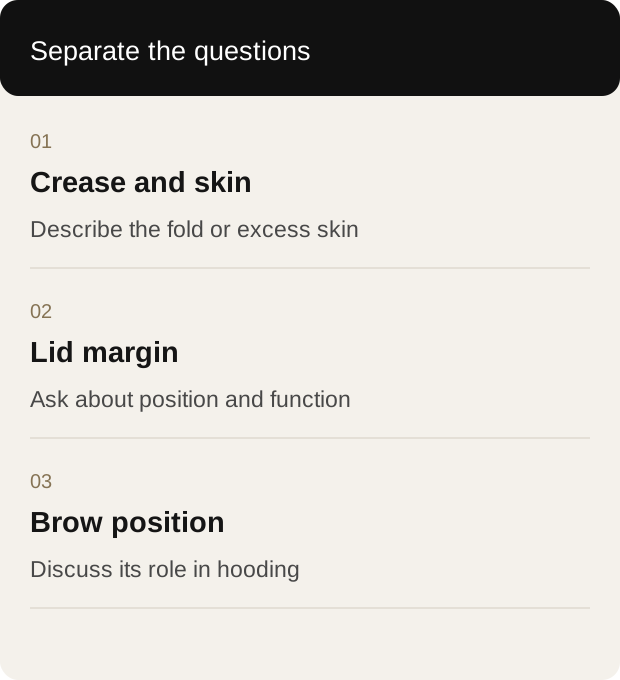
Ask the clinician to identify the crease, skin fold, lid edge and brow separately during the examination. Then ask which feature explains your main concern. This creates a shared vocabulary for comparing recommendations and makes it easier to notice when two quotations describe different operations.
When the conversation is about double eyelid surgery
Double eyelid surgery is most relevant to a request for crease creation or definition. Incisional techniques allow access to selected excess skin or fat as well as crease formation; suture-based approaches use a different route. The choice should follow the tissue assessment. Ask what will actually be changed, where an incision would lie and what the surgeon expects to remain unchanged.
A crease procedure should not be assumed to lift a low eyelid margin or reposition a low brow. If a proposal combines crease creation with ptosis correction, ask for both components to be named and explained. Likewise, 'eye opening' is an appearance description, not a sufficiently precise operative plan. You should understand whether the surgeon means changing the fold, treating the lifting mechanism or doing something else.
It is reasonable to prefer your existing crease or to want no new crease at all. Say this early. Ask the clinician to describe the proposed result in your own terms, including what you want preserved, before discussing method names or optional additions.
When ptosis needs its own assessment
Ptosis can affect one eye or both and may be present from birth or develop later. A clinician needs to establish the cause, assess eyelid position and examine how well the lifting muscle works. Changes in vision and the history of onset matter. It is not safe to conclude that every low-looking eyelid simply needs cosmetic muscle tightening.
The examination may include measurements, an assessment of eye movements and pupils, and visual-field testing when functional obstruction is a concern. Tell the clinician about previous eye operations, contact-lens use and whether the appearance varies through the day. Bring older photographs if available, but let the clinician decide what additional examination or investigation is appropriate.
Sudden new eyelid drooping needs urgent medical assessment, especially when accompanied by double vision, unequal pupils or other neurological symptoms. Do not wait for a cosmetic consultation or travel to Seoul to investigate a sudden change. NSW Health specifically identifies sudden-onset ptosis and associated neurological or pupil findings as emergency referral concerns.
When brow position changes the plan
A brow lift addresses the forehead and eyebrow tissues. Raising a descended brow may reduce the hooding that those tissues create over the upper eyelid. It is therefore relevant to some heavy-eye concerns even when the patient's attention is entirely on the eyelid. Conversely, a brow lift does not replace a complete assessment of the eyelid itself.
Discuss the shape and direction of the intended brow change, not just the amount of lift. Ask where the scars would sit, how the approach relates to your hairline, and whether the proposal might alter an expression you want to keep. A brow procedure has its own recovery burden and risks, including changes in sensation, hair loss near incisions, asymmetry and possible injury affecting facial movement.
When both brow and eyelid treatment are proposed, request an explanation of what each contributes and what a smaller plan would leave untreated. Combining procedures can be appropriate, but the fact that they can be performed together does not establish that you need both.
Make eye comfort part of the design
The upper eyelid protects the eye as well as framing it. Discuss dryness, irritation, existing difficulty closing the eyes and any treatment you already use. Ask how the proposed tissue removal or lid elevation will preserve comfortable closure. Removing too much skin can leave an eyelid too tight, while ptosis surgery can also leave the eye incompletely covered during closure.
Relevant complications include bleeding, infection, asymmetry, scarring, dry-eye symptoms and a result that requires further treatment. Eyelid surgery can rarely cause serious visual harm. A useful consent discussion connects these risks to your examination and the specific operation, rather than presenting a reassuring list of generic benefits.
Doing less or deciding against elective surgery is a valid outcome. If visual function or another medical condition is involved, ask what monitoring or treatment is needed even if you decline cosmetic changes. Ask directly whether an ophthalmologist should evaluate your symptoms before an aesthetic plan is finalized.
A consultation brief to send before travelling
Describe your concern in ordinary language and say when you first noticed it. Separate appearance goals from symptoms: for example, a hidden crease is different from difficulty seeing above you. List previous eye and forehead procedures, current medicines and supplements, allergies, eye drops and relevant medical conditions. Do not stop prescribed medicine independently to prepare for surgery.
Ask who will examine you, who would operate and whether the final plan is decided only after an in-person examination. A remote conversation can help organize records and clarify the clinic's process. It should leave room for the diagnosis, technique or suitability decision to change after examination.
Request a written proposal identifying each procedure, the reason for it, the anesthesia plan, follow-up appointments and total quoted charges. If one clinic recommends crease surgery alone and another adds ptosis repair or brow surgery, first compare their explanations of the anatomy. A price comparison becomes meaningful only when you understand the difference in scope.
Plan follow-up before planning your return flight
Early swelling, bruising and irritation can affect both comfort and appearance after eyelid surgery. Recovery instructions may include eye lubrication, wound care and restrictions on activities. Ask your own team when contact lenses, makeup, exercise and normal work can resume. A clinic's typical recovery description is not personal clearance to fly or a promise that the final crease will be visible by a particular date.
Arrange transport and suitable help after the procedure. Before paying a deposit, establish the required stay, the dates of examinations or suture removal, and what happens if another check is needed. Obtain a telephone contact for urgent concerns and a plan for care after you return home. New visual change or severe eye pain after surgery requires prompt medical assessment, not reassurance through photographs alone.
Keep a copy of the operative summary, medication instructions and follow-up findings. Ask how later asymmetry, persistent dryness or dissatisfaction would be assessed and whether additional consultations or revision carry separate costs. These questions help compare the whole course of care, rather than a surgery-day package.
A simple way to compare two surgical opinions
After each examination, make four headings in your notes: crease, excess skin, lid margin and brow. Under each, record what the clinician found, what they propose changing and why. Leave the clinical findings to the clinician; this is a record of the conversation, not a self-diagnosis worksheet. Add a separate question about comfortable closure and existing dryness. You should understand how the appearance plan protects the eye as well as changing its outline.
If one proposal includes brow surgery and another only discusses the crease, check whether they address the same concern. Ask what a smaller operation would leave unchanged and what the additional procedure contributes. Bring the first written plan to a second opinion rather than trying to reproduce it from memory. The aim is to understand the disagreement, not to persuade the next clinician to endorse the first.
Also describe what you want to keep: your crease, brow shape or familiar expression. Ask how the result would be assessed with the eyes open and closed, including the limitations of symmetry and scarring. A simulation can support that conversation but cannot guarantee an identical result. If the explanation still does not make sense, taking the plan away without booking surgery is a useful outcome of the consultation.
Listed clinics to consider for an informed consultation
Gangnam Seoyon Plastic Surgery is a relevant starting point for a crease or previous-eyelid-surgery concern. Its official international website lists eyelid and revisional eyelid surgery, and its profile of Dr. Dongil Choi describes double-eyelid and eyelid-revision work. Review the clinic and doctor profiles, then use the official international website to ask whether your concern needs a cosmetic eyelid consultation or an additional eye-health assessment.
Hugo Plastic Surgery offers another relevant consultation route when the question spans crease, lid position and forehead treatment. Its official profile of Dr. HyungKyu Kim lists double-eyelid, ptosis and revision eye procedures together with forehead lift work. Ask how these possibilities would be distinguished during your examination, rather than requesting all of them as a package.
These selections reflect verified topic relevance and current platform listings. Gangnam Seoyon receives platform placement priority under the site's commercial plan policy; priority is not evidence of better clinical outcomes. Provider service descriptions are their own statements. Choose after discussing your needs, the proposed operator and the practical follow-up arrangements.
A focused first enquiry might say: I am concerned about heaviness above my eyes, but I do not know whether the cause is skin, lid position or brow position. I would like an examination that explains those possibilities before choosing surgery. This gives the clinic a clear question and preserves your freedom to decide after consultation.
Clinics and doctors to explore
Use these profiles to prepare a consultation around the concerns above. Confirm who will assess you and which services are appropriate after an examination.
Gangnam Seoyon Plastic Surgery
Gangnam Seoyon lists eyelid and revisional eyelid surgery, and Dr. Dongil Choi’s official profile describes double-eyelid and revision work. Ask whether your crease or previous-surgery concern needs an eyelid consultation or an additional eye-health assessment.
Dr. Dongil Choi — professional profile →
Discuss a consultationHugo Plastic Surgery
Dr. HyungKyu Kim’s official Hugo profile lists double-eyelid, ptosis, revision and forehead procedures. This makes the clinic a relevant option for discussing how crease, eyelid position and brow position would be assessed separately.
Dr. HyungKyu Kim — professional profile →
Discuss a consultationRelevant Scale-up and PB listings receive placement priority; placement is not a ranking of clinical outcomes. Provider services and affiliations are checked against their official websites.
Common questions
Does double eyelid surgery correct ptosis?
Crease creation and ptosis repair have different targets. They may be combined when examination supports both, but a quote for double eyelid surgery should not be assumed to include ptosis treatment. Ask the surgeon to identify and explain each component.
Can I tell from a selfie whether I need a brow lift?
A selfie cannot establish the cause of heaviness. Brow position, excess skin and the eyelid margin need to be assessed together. Use photographs to explain what bothers you, then request an examination before choosing a procedure.
Should I book surgery before my Seoul consultation?
First clarify whether any payment reserves an assessment or commits you to an operation. Ask how cancellations and plan changes are handled if the in-person examination changes the recommendation. Leave space in your itinerary for investigation, a second opinion or deciding against surgery.