
Can rhinoplasty improve breathing as well as appearance?
It can, when the operation addresses the structures responsible for the breathing difficulty. A cosmetic change alone does not establish that a blocked nose will improve. If you are considering rhinoplasty in Korea and already notice restricted nasal breathing, make that concern part of the first enquiry. Ask for an assessment of function before choosing a preferred shape or booking an operation.
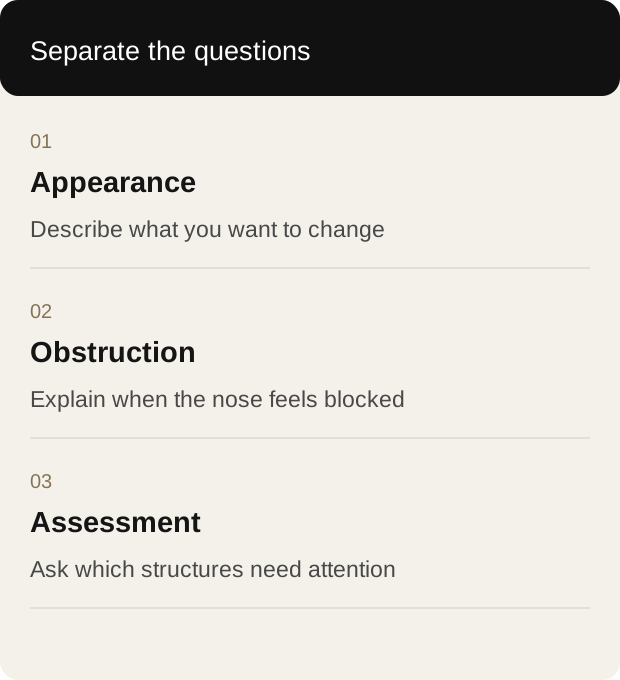
The useful question is more specific than whether a clinic offers functional rhinoplasty. It is: what is obstructing my nose, which part of the proposed operation addresses it, and what symptoms might remain? A combined consultation should leave you with two understandable goals: the change you want to see and the improvement you hope to feel. Both matter, but they need separate discussion and realistic expectations.
Describe the symptom before naming an operation
Prepare a short account of your breathing rather than arriving with a self-diagnosis. Note when the problem started, whether it affects one or both sides, whether it is constant or varies, and whether it followed an injury or earlier nasal treatment. Describe its practical effect: interrupted sleep, difficulty exercising comfortably, or needing to breathe through your mouth. These observations give the clinician a starting point; they do not identify the cause by themselves.
Include episodes of sneezing, itching, watery eyes or a runny nose, especially when symptoms appear around particular environments or exposures. The NHS identifies these as possible features of allergic rhinitis. A person seeking a straighter nose may also need treatment for inflammation. Record the names of sprays or allergy medicines you already use and whether they helped, rather than simply saying that you have tried medication.
Keep cosmetic preferences on a separate page. Identify the view or feature that concerns you and the features you would prefer to preserve. This makes it easier to discuss a smaller aesthetic change if the original request conflicts with the functional plan.
Understand the septum, the lining and the nasal valve
The septum is the internal partition of cartilage and bone between the nasal passages. A bend can occur naturally or after an injury. Septoplasty aims to straighten this partition; SingHealth describes persistent obstruction resistant to medical treatment as a common reason for considering it. A visible crookedness and an internal bend can coexist, but a photograph cannot tell you how much each contributes to your symptoms.
Turbinates are structures along the inside of the nose. Their size and the surrounding lining can contribute to obstruction. Inflammation is a different treatment target from a displaced structural partition, which is why the assessment should consider more than one explanation.
The nasal valve is another important airflow region. It may be narrow at rest or collapse inward during inspiration. The American Academy of Otolaryngology–Head and Neck Surgery explains that septoplasty and turbinate surgery are not substitutes for valve repair when valve dysfunction is present. That does not mean every blocked nose needs valve surgery. Ask the clinician to identify which structures are actually involved in your case and connect each proposed intervention to a finding.
What an examination adds to an online consultation
An online conversation can clarify your priorities and help a clinic decide which records to request. It should also identify what remains uncertain. Before travelling, ask whether the eventual assessment will include an examination of both the inside and outside of the nose, and whether the doctor discussing the plan is the doctor who would operate.
For nasal valve dysfunction, the AAO-HNS describes diagnosis as clinical, based on history and physical examination. Endoscopy can help identify other causes of obstruction, while CT does not measure dynamic valve collapse. A clinic advertising advanced imaging is therefore not, by that fact alone, answering every functional question. Ask what a proposed test is intended to clarify and whether its result would change the treatment.
After the examination, ask for the findings in plain language. You should be able to explain why the suggested plan fits your symptoms, which uncertainty remains, and what the clinician expects to reassess. A confident presentation is less useful than a clear explanation you can take away and compare.
Separate septoplasty, functional work and cosmetic changes
Septoplasty focuses on the septum. Septorhinoplasty combines work on the septum with changes to the external nasal framework. ENT UK explains that a severe septal bend or an associated twist in the outside of the nose may require attention to both. Functional rhinoplasty is a broader description of work intended to improve nasal function; ask for the actual structures and procedures behind that label.
A practical comparison has three columns in your own notes: the problem identified, the proposed correction, and the expected benefit. For example, ask which work is intended to improve airflow and which is intended to change appearance. If a graft is proposed, ask where it would come from, what support it would provide, and what additional considerations arise at a donor site.
You do not have to choose cosmetic changes simply because functional surgery is being discussed. Equally, deciding to change appearance does not make breathing symptoms secondary. Ask whether treating only the functional concern, combining both goals, or postponing intervention would each be reasonable for you.
When treating inflammation or doing less may be appropriate
Allergic rhinitis can cause a blocked nose even when the main concern you notice in the mirror is shape. A clinician or pharmacist may recommend treatment such as an antihistamine or nasal spray when appropriate. The NHS advises seeking medical assessment when the cause is uncertain, symptoms affect everyday life or sleep, or pharmacy treatments are not helping. Bring that history into a surgical consultation rather than assuming an operation will remove every source of congestion.
Medication can reduce inflammatory symptoms but does not physically straighten a bent septum. Likewise, a structural operation is not a promise that allergy symptoms will disappear. Ask which symptoms are expected to respond to each part of care and whether ongoing medical treatment could still be needed.
Observation is also a legitimate choice when symptoms and appearance concerns do not justify the burden of surgery. ENT UK makes clear that the decision to pursue treatment remains yours. An assessment can be valuable even when its outcome is a more limited plan or a decision to wait.
Bring records that let the surgeon evaluate both goals
Bring your medical history, medication and supplement list, allergies, and details of earlier operations. Include nasal procedures performed elsewhere, even if you regard them as minor. The American Society of Plastic Surgeons includes previous treatment, health conditions and substance use among consultation topics. Be open about what you hope to achieve and what would make the recovery or uncertainty difficult for you.
For previous nasal surgery, request the operation report and information about any inserted material if available. Mark the date when breathing changed relative to that treatment. Avoid assuming that an earlier operation explains every present symptom; the new assessment still needs to establish the cause.
If you need interpretation, confirm how detailed consent discussions will be supported. Send your priorities beforehand and bring the same written questions to each appointment. Before leaving, ask for the proposed plan in writing. This makes a later comparison possible without relying on memory, sales summaries or a collection of before-and-after photographs.
Ask about breathing risks as carefully as cosmetic risks
Rhinoplasty can leave persistent breathing difficulty or introduce new difficulty. Other risks described by the American Society of Plastic Surgeons include infection, poor healing or scarring, altered sensation, an unsatisfactory appearance, anesthesia complications and further surgery. Septal perforation, a hole in the internal partition, is another possible complication. These risks belong in the discussion even when the operation is described as functional.
Ask the surgeon which risks are especially relevant to the changes being proposed. If narrowing, reduction or reconstruction is part of the plan, ask how support and airflow will be considered. Ask which concerns might remain despite technically successful surgery.
A useful consent conversation also names limits. Ask which concerns are unlikely to change and which outcomes cannot be predicted precisely. Take time to consider the answers. A consultation should help you make a decision you understand, including declining treatment.
Plan follow-up around function, not just the first photograph
Early recovery may involve internal packing or splints, external support, swelling and changing appearance. ASPS explains that nasal contour can continue refining long after the initial swelling has improved. A clear photograph at an early appointment therefore cannot settle every question about the eventual result.
Before travel, ask how the team will monitor nasal breathing and what symptoms should trigger contact. Get the dates or criteria for postoperative reviews, removal of any supports, and permission to resume activities. Your itinerary should allow the treating team to individualize assessment and travel advice rather than forcing care into a fixed holiday schedule.
Agree on what happens after you return home: who reads messages, how quickly concerns are assessed, when an in-person examination would be needed, and what records can be shared with a local clinician. Record both the clinic's routine contact route and its urgent-care instructions. These arrangements are part of the treatment decision, not an administrative detail to leave until discharge.
Agree how both goals will be reviewed
Before committing, ask how follow-up will assess breathing as well as photographs. Describe the ordinary activity you hope will feel easier and ask whether that expectation fits the findings. Early recovery and longer-term assessment are different conversations; obtain the treating team's explanation of when each concern can reasonably be evaluated rather than borrowing another patient's timetable.
Discuss two possibilities separately: the appearance is acceptable but obstruction persists, or breathing improves but the shape is disappointing. Who would examine you, when would an in-person visit be necessary, and what would reassessment cost? These questions do not predict a poor result. They help establish whether the care arrangement answers both of your original goals.
For a second opinion, compare three items in each written proposal: the finding, the action and the intended benefit. Septal work and valve work are not competing marketing labels for one identical operation. Ask whether different recommendations reflect different findings. Make sure any change after the in-person examination is reflected in the final quotation and consent discussion, including the implications of a donor site if your own cartilage is proposed.
Compare written plans before comparing totals
Ask for an itemized quotation that identifies the functional and cosmetic components, the treating doctor, anesthesia, facility charges, investigations, medicines and included follow-up. If grafting or additional procedures are proposed, make sure the quoted scope matches the explanation you received. Two prices are not directly comparable when they describe different operations or different aftercare arrangements.
Treat insurance eligibility as a separate question requiring confirmation from your own insurer. A functional label in an advertisement is not an authorization for reimbursement. For care in Korea, request any documents your insurer needs before making financial commitments. Also clarify the charges and responsibilities if reassessment, additional treatment or an extended stay becomes necessary. These are practical planning questions, not predictions that a complication will occur.
Clinics and doctors to explore
Use these profiles to prepare a consultation around the concerns above. Confirm who will assess you and which services are appropriate after an examination.
Kobijou Rhinoplasty Clinic
Kobijou Rhinoplasty Clinic is a relevant listed option for a consultation linking appearance with nasal function. Its international website lists functional rhinoplasty, deviated septum and nasal obstruction services. The official profile of Dr. Sang-Min Hyun describes functional and aesthetic nasal surgery, including revision cases, and reports ENT residency and rhinology fellowship training. These are provider-published details, not an independent credential assessment. Review the clinic and doctor profiles, then use the international website to request an assessment of your breathing symptoms and cosmetic priorities. Ask which investigations and procedures, if any, would be appropriate for you.
Dr. Sang-Min Hyun — professional profile →
Discuss a consultationRelevant Scale-up and PB listings receive placement priority; placement is not a ranking of clinical outcomes. Provider services and affiliations are checked against their official websites.
Common questions
Does a deviated septum always need surgery?
No. The decision depends on symptoms, examination findings and the expected benefit relative to the risks. Ask whether the septal bend explains the problem and whether other causes should be treated first. A consultation does not commit you to an operation.
Can I have breathing treatment without changing how my nose looks?
Sometimes a plan can focus on the internal obstruction, but the answer depends on the structures involved. Ask the surgeon to explain any appearance change expected from the functional work, including changes you may not have requested.
What should my first message to a Korean clinic include?
State that you want assessment of breathing as well as appearance. Summarize the symptoms, previous nasal treatment and your main cosmetic priority. Ask who assesses nasal function, what needs an in-person examination, and how follow-up will work after you return home.