
Start with what changed: colour, texture or new breakouts
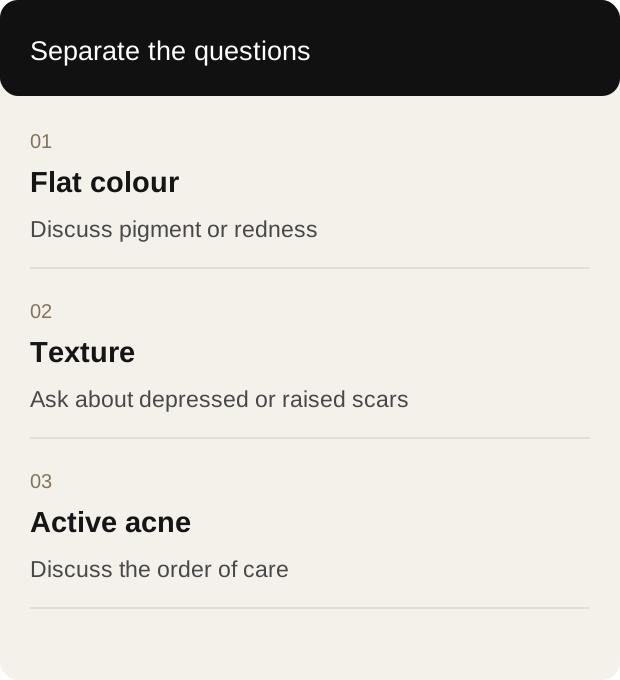
Acne marks and acne scars are often used as if they mean the same thing. They can describe different problems. A flat patch left after a spot heals may be a colour change; a persistent dip or raised area involves altered skin texture. Both can occur together, alongside active acne. Before choosing a skin treatment in Korea, ask a dermatologist to separate these concerns and explain which one each proposed treatment addresses.
The useful first appointment is therefore a diagnostic conversation. You do not need to arrive knowing the right laser or asking for a particular package. Arrive knowing what bothers you: dark marks in photographs, unevenness under side lighting, recurring painful spots, or several concerns at once. That distinction gives the consultation a clear purpose and makes the eventual recommendation easier to understand.
Flat marks are different from indented or raised scars
Post-inflammatory hyperpigmentation, often shortened to PIH, is excess pigmentation following inflammation or injury. Acne can leave brown or darker patches after the original spot settles. Residual redness may also follow a breakout. Neither colour alone nor a photograph is enough to establish exactly what is happening in your skin. A clinician needs your history and an examination, particularly when a mark does not behave as expected.
True acne scars can be depressed or raised. Depressed patterns include narrow, deep ice-pick scars, broader boxcar depressions and rolling, uneven contours. Raised scars involve excess scar tissue. Knowing these names can help you follow a consultation, but matching yourself to an online picture is not a diagnosis. Different patterns may sit close together, and a colour change can make a depression seem more prominent.
Ask the clinician to point out the concern on your own face: which areas are mainly pigment, which have a structural change, and which are still inflamed? If several things are present, request a separate goal for each. Otherwise, you may judge a successful reduction in pigmentation as a failed treatment because your original expectation was smoother texture.
Why new acne changes the order of care
If breakouts are continuing, preventing further damage is part of the decision. The American Academy of Dermatology explains that scar treatment commonly follows control of active acne. Treating the surface left by earlier breakouts does not, by itself, provide a plan for new ones. A consultation may therefore lead to acne care first, with a later review of the remaining marks or scars.
Tell the doctor whether spots are becoming deeper, painful or more frequent, and whether they leave new marks. Bring the names of prescribed medicines, over-the-counter products and previous procedures, together with dates and any reactions. Include past isotretinoin use. Some acne medicines can affect suitability or timing for a procedure; the treating clinician should assess the particular combination rather than applying an internet waiting-period rule.
A useful written plan distinguishes the immediate goal from the later one. For example, the first goal might be fewer new breakouts; the later discussion might concern persistent colour or texture. Ask what would show that the first phase is working, when it will be reviewed and who will supervise it after you leave Korea. Do not stop prescribed treatment simply to fit a travel appointment.
Make your skin history more useful than a treatment wish list
Prepare a short timeline before contacting a clinic. Note when acne started, when the marks appeared, whether their appearance is changing, and what you have already tried. Describe reactions plainly: a product stung, a procedure left prolonged darkening, or a scar became raised. The information helps the clinician understand your experience without requiring you to supply medical terminology.
Bring unfiltered photographs that document earlier changes, together with the dates and treatments used. Tell the clinic if your main concern is something that photographs fail to capture; the examination should address that concern directly.
For an international visit, ask who will assess you and whether you can discuss the findings directly with that doctor before deciding on treatment. Confirm how interpretation and written instructions will work if needed. An English website does not automatically establish that every part of your appointment will be conducted in English.
A concise message can make the first exchange productive: explain that you have lingering marks after acne, say whether new breakouts continue, give your travel dates and ask for an examination to distinguish pigmentation from scarring. Ask for the consultation fee and whether a treatment decision can wait until after the examination. You are requesting a medical assessment, so there is no need to choose a device from a price list in advance.
Skin tone and previous pigmentation deserve their own discussion
Post-inflammatory pigmentation can affect any skin tone, but it can be more pronounced and last longer in darker skin. Sun exposure can darken affected patches. Procedures intended to improve pigmentation can sometimes worsen it by causing further injury or inflammation. This is a reason to discuss your individual risk, not a reason to assume that every procedure is unsuitable.
Ask how the recommendation accounts for your natural skin colour, recent sun exposure and earlier pigment reactions. If you previously developed dark or pale patches after treatment, explain what happened and how long it lasted. Request an explanation of the alternatives, including a less intensive approach or postponement. A named device is only one part of that discussion.
Also ask for a practical skin-care plan that fits both your journey and your life at home. Clarify sun protection, products to pause or continue, and who to contact about irritation. Avoid building your own combination of exfoliants and brightening products while waiting for the consultation; bring your current routine so the clinician can review it.
Compare the purpose of a procedure, not just its name
A proposed peel, laser or needling session should come with a defined target. Ask whether the aim is colour change, a particular scar pattern or another concern. Then ask what that approach is unlikely to improve. You can accept a limited benefit when the limitation is clear; an undefined promise to improve everything is much harder to assess.
Microneedling illustrates why terminology matters. The FDA describes medical devices that penetrate skin with needles and notes that suitability and infection risk require discussion with a trained provider. Radiofrequency microneedling adds energy delivery and should not be treated as interchangeable with ordinary needling. In its October 2025 safety communication, the FDA reported serious complications with certain RF microneedling uses, including burns, scarring, fat loss and nerve damage.
If this is proposed, ask for the exact device, why it fits the diagnosed concern, the practitioner’s relevant training, and how complications would be managed. The FDA information is safety context from the United States; it is not evidence that a particular Korean clinic or device has been evaluated or endorsed by that agency.
Decide what improvement would be worthwhile
Scar treatment is optional, and scars rarely disappear completely on their own. The decision should reflect how much the concern affects you and what trade-offs you accept. You may prefer to address active acne, allow marks time to change, seek improvement in one area or decide against a procedure. A consultation can be useful even when it ends without treatment.
Choose a specific outcome to discuss rather than an idealised complexion. Would less contrast between marks and surrounding skin be worthwhile? Is one cheek’s texture your priority? Would the expected improvement justify repeat appointments? These questions help you distinguish your own goals from the broad language of a package description.
Agree how progress will be assessed and when a decision about further treatment will be made. Comparable photographs and an explanation of what has changed are more informative than judging yourself immediately after each visit. Ask what would lead the clinician to pause, revise or discontinue a proposed course.
A short Seoul visit needs a follow-up plan
A convenient appointment does not establish that an entire course fits your stay. Tell the clinic your arrival and departure dates before paying for a package, along with any events where visible recovery would be difficult. Ask whether the proposed first visit is an examination, a treatment or both, and whether you can decide after hearing the findings.
Request an itemised written proposal that separates consultation, procedures, prescribed products and review appointments. If several sessions are suggested, ask what is included now and what would require another payment or trip. This makes comparison meaningful without assuming that a lower advertised session price represents the same scope of care.
Before proceeding, identify the person responsible for follow-up, the channel for questions, and what happens if an in-person assessment is needed after you return home. Obtain treatment details you can share with another clinician. Ask for procedure-specific instructions on expected recovery and symptoms requiring prompt assessment; a generic beauty-treatment leaflet may not answer those questions.
If you are comparing two recommendations, keep the diagnosis beside each quotation. One proposal may focus on pigmentation while another addresses depressed scars; those are different aims even when both are labelled acne-scar care. Ask each clinician to explain the difference before deciding. Taking time to reconcile conflicting advice is a reasonable part of making an informed choice.
Make progress photographs and package reviews useful
Ask how the clinic documents your starting point and when photographs will be useful for assessing change. Keep lighting, angle and distance comparable in your own records, without beauty filters. Side lighting can change the shadows around depressions, while exposure changes can alter the apparent contrast of pigmentation. Photographs support a conversation; they do not replace examination when symptoms or a new treatment decision require one.
Before buying several sessions, ask what will be reviewed after the first and what could lead to a pause or a different plan. A prepaid number of visits does not establish that the same intervention remains appropriate each time. Clarify expiry dates, unused sessions, changes and refunds separately from the clinical decision. Include any other procedures or new products you plan during the trip so the clinician can consider the actual combination.
Finally, clarify how clinical photographs will be used and who can access them. Recording your care and advertising a treatment are different purposes. Read the consent wording and state your preference before images are shared. You do not need to publish your face in an online review to explain a concern to the treating team.
A listed clinic and doctor to consider for this discussion
Delight Dermatology Clinic is a relevant starting point because its international website separates pigmentation, acne and redness, and scars and pores into distinct service categories. The clinic’s official profile for Dr. Yun Sang Youl lists acne, pigmentation disorders and laser therapies among his clinical areas. Those published interests connect directly with the question of whether a concern is ongoing acne, residual colour or scarring.
Review the platform’s Delight clinic profile and Dr. Yun’s profile, then use the clinic’s international website to ask about a diagnostic consultation. Describe your main concern and current acne treatment, and confirm which doctor would assess you. The selection is based on listed services and the clinic’s own doctor information; it does not predict your suitability or result.
Clinics and doctors to explore
Use these profiles to prepare a consultation around the concerns above. Confirm who will assess you and which services are appropriate after an examination.
Delight Dermatology Clinic
Delight lists acne, pigmentation and scar services; its official Dr. Yun Sang Youl profile identifies acne and pigmentation among his clinical areas. Review the clinic’s international website to request a consultation about the cause of your marks.
Dr. Yun Sang Youl — professional profile →
Discuss a consultationRelevant Scale-up and PB listings receive placement priority; placement is not a ranking of clinical outcomes. Provider services and affiliations are checked against their official websites.
Common questions
Can a flat brown acne mark improve without a procedure?
It may fade over time. A dermatologist can assess the cause and discuss observation, skin care or treatment when appropriate. A mark that is flat is not automatically an indication for scar resurfacing; the first question is what produced the colour change.
Should I book a scar package if I still have breakouts?
Book an assessment before committing to a course. Active acne can change the order of treatment, and the plan may initially focus on preventing further breakouts. Ask how the clinician will decide when to reassess persistent marks or scars.
Can one appointment address every mark and scar?
Do not plan around that assumption. Ask which concerns could reasonably be assessed or treated during your stay and which would need later review. The decision depends on the examination, the proposed method and your ability to obtain follow-up.